Part Three · A concept for AI-aware course design
A room built for attention.
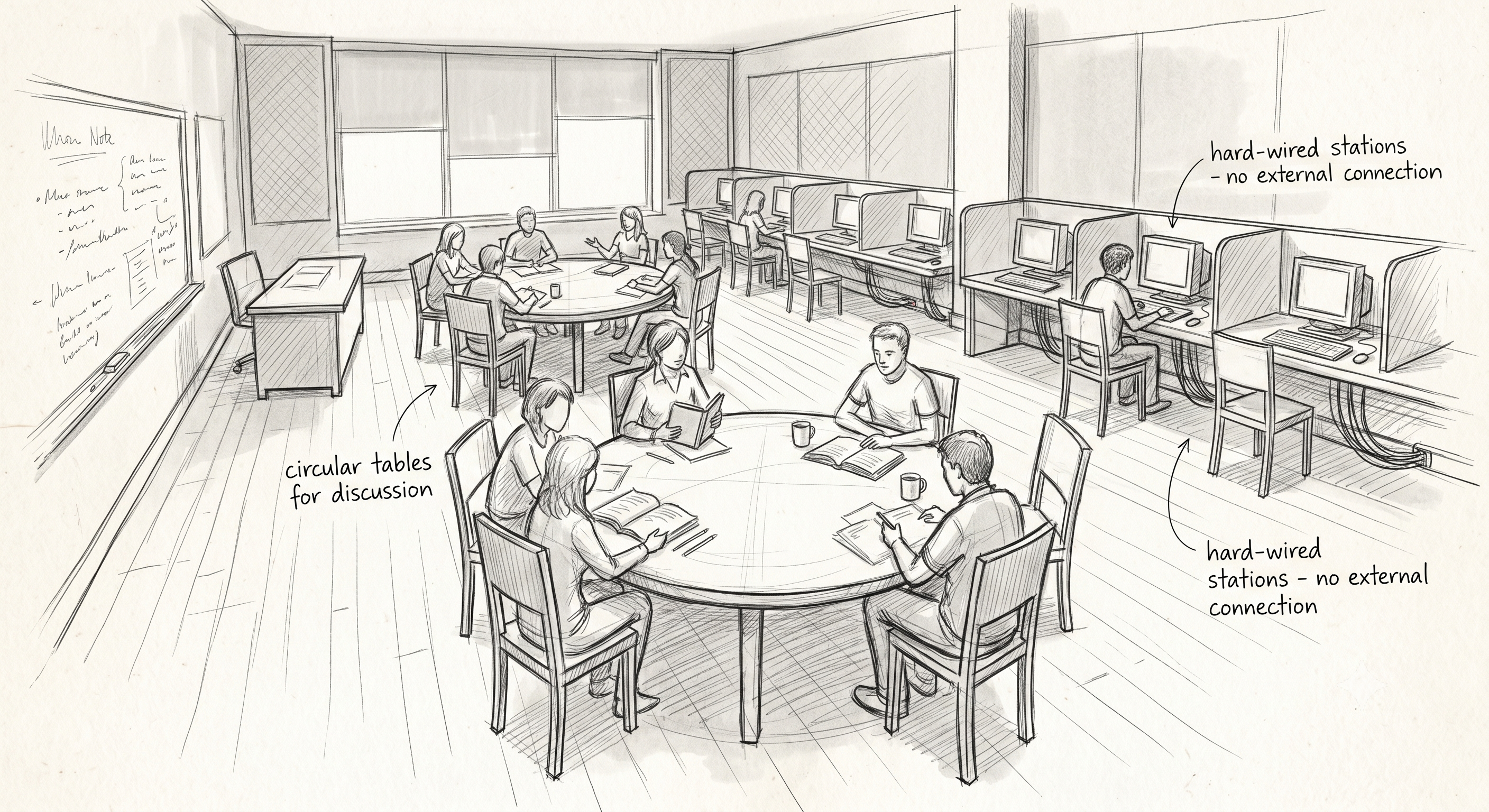
One day a week, a reduced-distraction room protects the thinking: hard-wired stations with no outside connection, round tables for the talk. The other days stay open — internet on, AI in the mix. The goal isn't to keep AI out. It's to make sure students can think with it and without it.
hard-wired computers · no internet · no AI
The idea
The room does the work the syllabus can't.
Policies and honor codes ask students to resist a tool that is one tab away. A focus classroom removes the temptation from the environment instead — so attention is the path of least resistance, not an act of willpower. It's a modest intervention: book it like you'd book a lab, one session a week.
Four design principles
Every object earns its place
Reduced distraction
The room shapes the policy, so the syllabus doesn't have to do the heavy lifting.
Purposeful design
Every object in the room earns its place — nothing decorative, nothing accidental.
Deep learning
Long, uninterrupted stretches of reading, writing, and group work.
Student well-being
A sanctioned break from the feed — one many students quietly want.
Two rooms, one course
The focus room only works as half of a rhythm
One day a week · Focus room
Build the foundation
No internet, no AI. Deep reading, drafting, and problem-solving — the core skills that become the student's foundation.
offline · analog · theirs
The other days · Open classroom
Use digital tools well
Internet on, digital tools encouraged, AI in the mix. Students research, iterate, and collaborate — and learn to use these tools well.
online · digital · AI in the mix
Explore
Start with the room, then see how it fits your week
Walk the Room
Click any object in the sketch to see the design challenge it solves and how to run it with students.
Design Principles
The four principles behind the room — reduced distraction, purposeful design, deep learning, well-being.
One Day a Week
How a single focus session drops into the three most common teaching schedules — MWF, Tue/Thu, hybrid.
Two Rooms, One Course
Foundation first, then fluency: the focus day and the open days as two halves of one design.
Across the Week
What the focus day protects and what the open days build — for writing, STEM, and the humanities.