Part Three · The Focus Classroom
Design Principles
The focus classroom is not minimalism for its own sake. Four principles decide what goes in the room and what stays out — and each one moves a burden off the syllabus and onto the space itself.
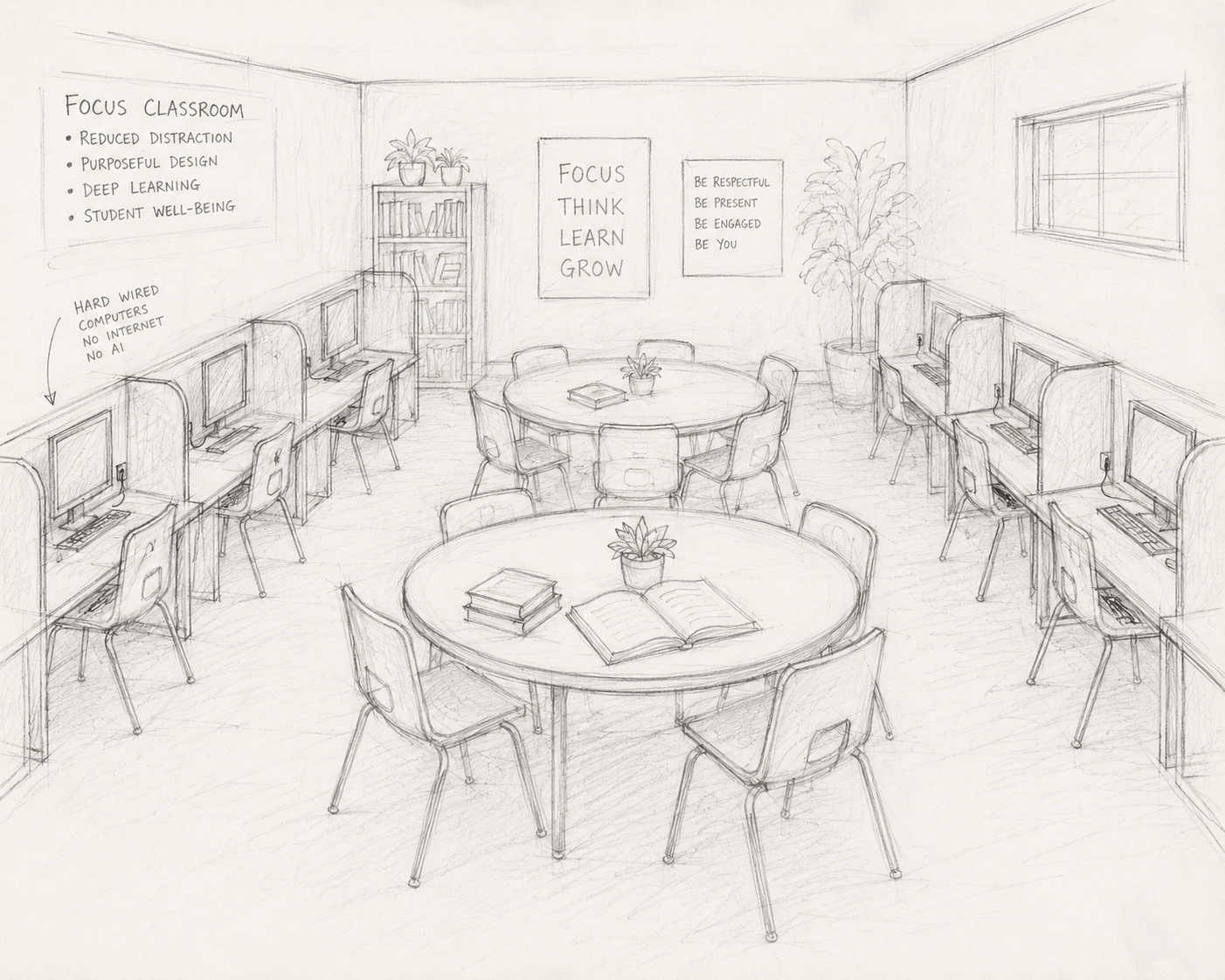
hard-wired computers · no internet · no AI
Reduced distraction
The room shapes the policy, so the syllabus doesn't have to do the heavy lifting. When the open web and AI aren't within reach, staying on task stops being a test of willpower and becomes the default.
Purposeful design
Every object in the room earns its place. The hard-wired stations, the round tables, the analog reading table, the boards on the wall — each answers a specific pressure that generative AI puts on learning.
Deep learning
Long, uninterrupted stretches of reading, writing, and group work. The layout protects the kind of sustained attention that summary tools are built to shortcut, so the hard cognitive work actually happens.
Student well-being
A sanctioned break from the feed — one many students quietly want. Surveys keep finding students who'd welcome time away from constant connectivity; the room offers it without making it a discipline problem.
See it in place
Every principle maps to an object you can click
The interactive room turns these principles into fourteen specific design choices — each with the challenge it answers and how to run it with students.